
Some Questions Are Worth Asking Before the Fence Fails


A wall of worry is starting to build in both equity and bond markets that is somewhat hidden due to the fact that equity indices continue to reach all-time highs. Plastered on
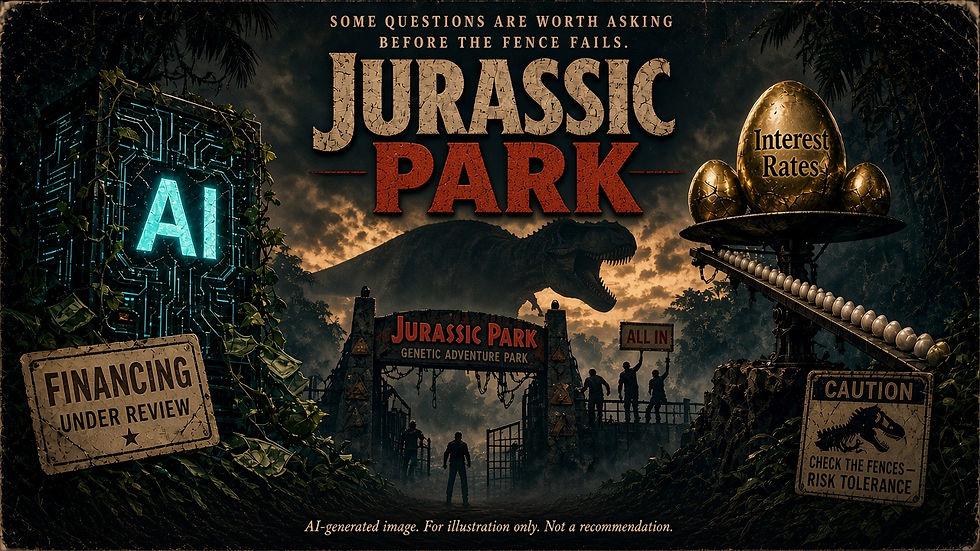
the wall are worries over sticky inflation, hyperscaler financing, weak market breadth, and rising interest rates. This week we gather inspiration from the 1993 film "Jurassic Park". We have used this film for inspiration before in 2022, but the current market themes and movie symmetry were "fire" (as the kids say). Here is some trivia about the movie:
This movie was somewhat of a surprise in 1993. It was expected to fall in line with numerous predecessors with troublesome special effects. However, Spielberg shocked the world by employing photorealistic CGI. The dinosaurs that were computer-generated that moved and interacted with live-action footage for the first time in movie history. This discovery was made mid-production and completely changed the picture, as well as the movie industry forever.
The film was the top-grossing movie in 1993, earning more than $1 billion at the box office. Since then, the movie franchise has churned out 7 films, so far, earning more than $6 billion worldwide.
Ariana Richards, who plays the young girl Lex, did little but scream for her audition tape. Spielberg wanted to see how the actresses could show fear. When he played the audition tapes at home, Richards' was the only one that woke Spielberg's sleeping wife off the couch and he knew she was the one for the role.
The author of the book, Michael Crichton, was asked why the novel was titled "Jurassic" when the dinosaur on the cover of the book was from the Cretaceous period (which came after the Jurassic period). He replied, "That was just the best looking design."
James Cameron has stated that he wanted to make this movie, but the rights were purchased a few hours before he could bid for them. After watching the finished movie, he admitted that Spielberg was the better choice as his version would have been much more violent.
Here's what we've seen so far this week...
Spare No Expense. The creator of Jurassic Park, Mr. John Hammond, repeatedly says this line when describing how he put the park together. That is certainly the case for artificial intelligence as hyperscalers, software developers, semiconductors, and, more
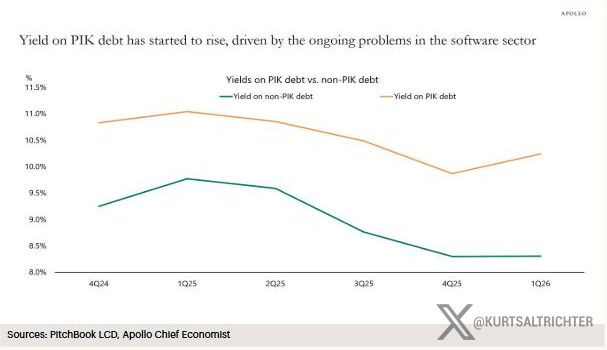
importantly, private equity have spent more than $1 trillion on the AI buildout.1 While the buildout has been necessary, to a degree, in order to generate the computing power required of AI, the question now is have they overspent and did they finance the buildout responsibly? According to Morgan Stanley, approximately $700 billion of the AI buildout has utilized private credit issued by private equity companies.2 Private credit often utilizes PIK (payment-in-kind) rates. Jeffrey Gundlach recently stated his concerns over PIK rates as defaults on private credit have moved higher to 6.3%.3 To use his simple example, a company lends $100 to a company for AI build out with a 10% interest owed annually. At the end of the year, if that interest (in this case, $10) isn't paid, it is simply tacked on to the principal, making the loan now $110.3 Stress is moving higher in that environment, as the graph above shows yields on PIK rates increasing.
At the same time that AI financing is coming under question, the reality of AI revenue growth and usage is also coming under question. We touched on the efficiency of new
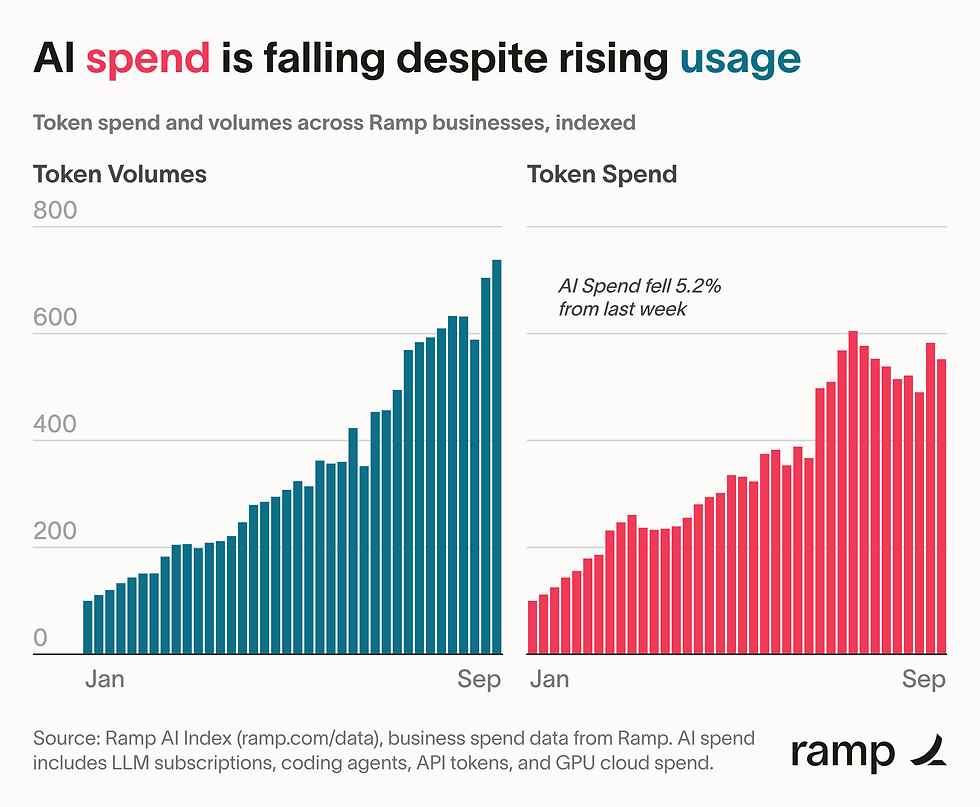
AI models and better semiconductor chips that have made AI technology better several weeks ago.4 That is starting to show up in the numbers as the amount of spending (tokens) on AI has dropped after peaking earlier this year (as shown in the graphic). This is happening as AI adoption is increasing along with usage. The question of revenue generated by AI companies could be quite important given the aggressive financing being undertaken for the AI buildout.
Star Attractions? After things begin to go wrong in "Jurassic Park," the park's owner, John Hammond, notes the problems Disneyland had when it first opened in 1956. To which Dr. Malcolm responds, "Yeah, but John, if the Pirates of the Caribbean ride breaks
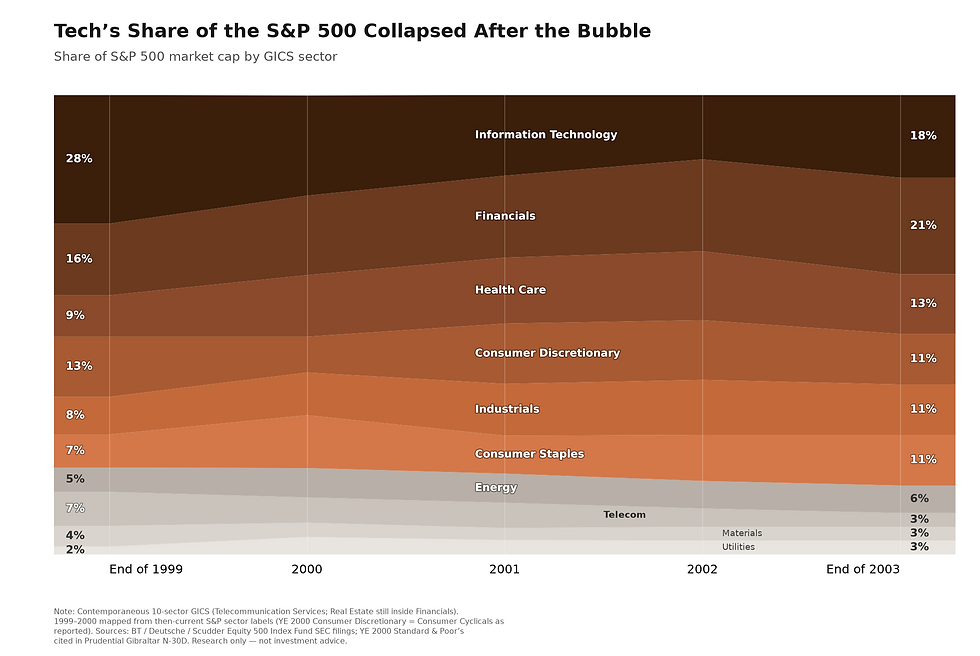
down, the pirates don't eat the tourists." Markets are wonderful instruments to build real and lasting wealth. However, without a proper balance of risk, markets can remove some of that wealth, as well. We noted last week how concentrated the S&P 500 Index has become in technology stocks, largely due to AI.5 As the graphic shows, the same occurred in 1999. Technology reached approximately 28% of the S&P 500 Index. As the Dot.com bubble burst, information technology came back down to a more reasonable level of approximately 18%.
When a portfolio is exposed to stocks that are part of the concentration and those stocks are moving higher, concentration feels like a very good thing. However, when the
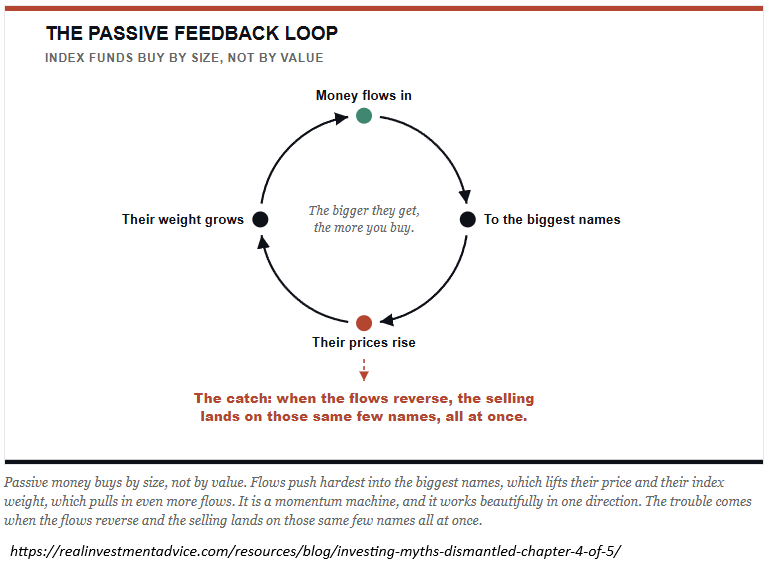
flows change and those concentrated stocks come under pressure, concentration doesn't feel so good. That effect may be important in the future as ETF investing has become increasingly the norm for retail portfolios.6 The passive feedback loop that could be experienced by ETF investors indicates that when money flows into an instrument that tracks an index, the bigger names (by market capitalization) could get bigger as their prices quickly rise. However, as shown in the graphic, the opposite could also be true when the flows reverse. The bigger names could drag the instrument (and, possibly the underlying index) down with them. The attractions at the amusement park are the most sought after by prospective riders, but they also have the longest wait lines.
Objects In The Mirror Are Closer Than They Appear? As the Jurassic Park systems have to be taken offline in order to fix the boobytraps installed into the system by disgruntled employee Nedry, the dinosaurs start to escape and hunt the invitees. Such
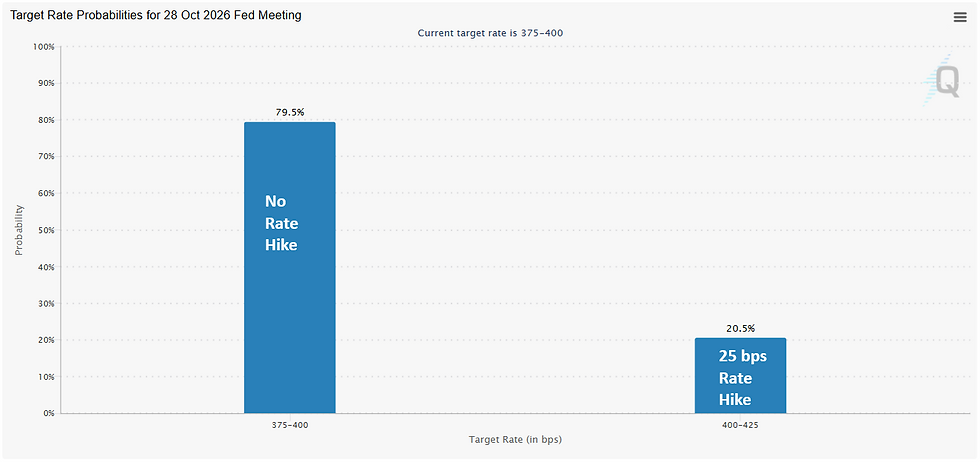
may be the case with investors who have stretched equity and bond risk in their respective portfolios. A poor jobs report this morning showed that only 29,000 new jobs were created in September versus 89,000 expected.7 In addition, last month's number of 162,000 new jobs was revised lower to 133,000.7 This revelation sent probabilities higher that the next Fed decision later this month could be no rate change.8 Counterintuitively, this has helped push equities higher in trading as a response to the potential for steady rates in October.
Steady is not exactly the case for interest rates over the past several weeks as the yield on the 10-year Treasury Bond has increased 86 basis points over 93 days.9 This has
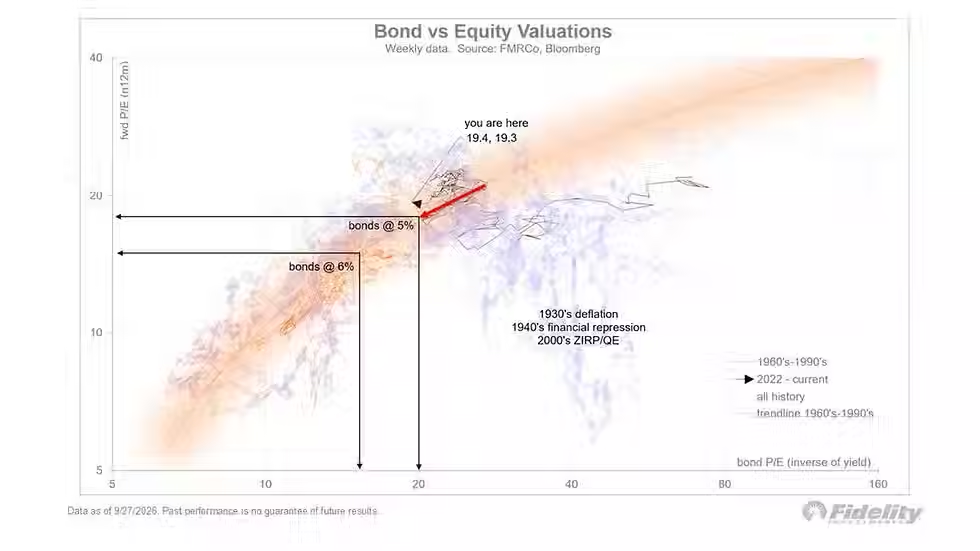
implications for equity and bond investors alike. First, for the bond investor, as interest rates rise, risk for holders of longer duration bonds also rises. Investing on the shorter end of the yield curve could help dampen bond volatility as interest rates rise. In addition, and second, equities could become unsettled if bond yields were to risk closer to 6%. According to the Fidelity graphic, price-to-earnings ratio on the S&P 500 Index are around 20x. However, if the yield on the 10-year Treasury were to rise to 6%, that has historically changed the P/E valuation of the S&P 500 Index from 20x to 16x. It's possible that could lead to an over-valued situation for equities, leading to downward pressure. There is still a case for equities to perform well if yields stay manageable, however, as we have been noting, investors would be wise to review their investments to ensure risk tolerance matches return expectations.
Click here to watch Dr. Malcolm declare, "Must go faster".....
_________________________________________________________________________________________
Disclosures
The information contained herein is for informational purposes only and is developed from sources believed to be providing accurate information. The opinions expressed are those of the author, are for general information, and should not be considered a solicitation for the purchase or sale of any security. The decision to review or consider the purchase or sell of any security should not be undertaken without consideration of your personal financial information, investment objectives and risk tolerance with your financial professional.
Forecasts or forward-looking statements are based on assumptions, may not materialize, and are subject to revision without notice.
Any market indexes discussed are unmanaged, and generally, considered representative of their respective markets. Index performance is not indicative of the past performance of a particular investment. Indexes do not incur management fees, costs, and expenses. Individuals cannot directly invest in unmanaged indexes. The S&P 500 Composite Index is an unmanaged group of securities that are considered to be representative of the stock market in general.
Past Performance does not guarantee future results.

Comments