
More Volatility, But Perhaps A Rebound On The Horizon


After suffering from the metals rout, equities bounced back in a big way late last week. Looking back over the past 20 years, February is one of the worst months of the year

and has only a 50:50 probability of ending the month positive. On the other hand, March and April tend to be much stronger months with a 63% and 79% probability, respectively, and ending the month higher or positive. Of the major sectors of the S&P 500, on 6 were positive year-to-date, prior to Friday's recovery. However, we have a math problem. Technology stocks make up more than 33% of the Index. That being said, market breadth is still healthy. More than 66% of stocks in the S&P 500 are above their 200-day moving averages and new lows on the New York Stock Exchange are below what would be considered a "high risk" environment.
The ISM Manufacturing PMI has been at or below 50 for the past 9 months. When this index is below 50, the manufacturing sectors is generally considered to be contracting.
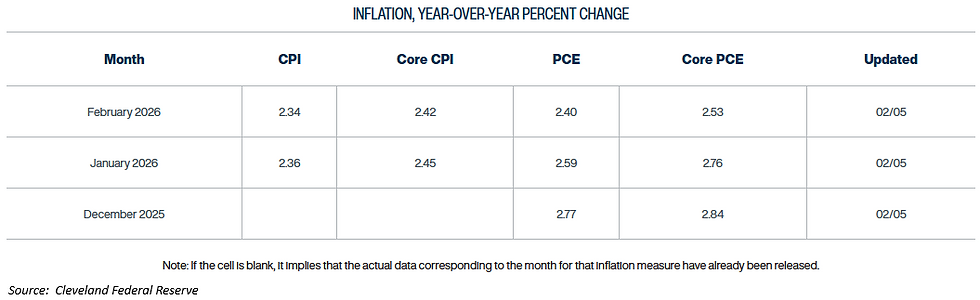
However, last week the index jumped from 47.9 to 52.6. We haven't seen a one-month move that strong since 2021. The Atlanta Fed has 4th quarter GDP coming in higher than 4%. We will get the first reading of Q4 GDP in two weeks, but the weekly economic index tracked by the St. Louis Federal Reserve shows a reading north of 2.0, which is accompanied by economic expansion, not contraction. According to the Cleveland Federal Reserve, their inflation expectation for January is +2.4%, which if true, would be a decline of -0.3% compared to December. Their February expectation is for inflation to be nearly flat at +2.4%. This scenario would be a tailwind for consumers moving forward.
There has been considerable movement in the metals market lately, especially silver. This movement has bled over into other metals and liquid equity names that are highly

appreciated. What we are witnessing is not a fundamental shift in the metals supply and demand structure. Lease rates on silver have risen, which tells us that the physical demand for silver has not collapsed, rather there has been an over-abundance of leverage in the paper price of silver. The Silver Institute reports that demand for silver still remains elevated and exceeds supply. Over the last 55 years, silver has seen considerable drawdowns from 12-month highs at least 10 times, prior to this year. The average drawdown was -25% and averaged 41 days to reach a new low. This year, in just 8 days we've seen the price of silver decline 39%. Metals trading seemed to settle down on Friday and appear to be relatively calm in early trading Sunday evening. We'll see if market volatility eases this week or stayed elevated.
Disclosures
The information contained herein is for informational purposes only and is developed from sources believed to be providing accurate information. The opinions expressed are those of the author, are for general information, and should not be considered a solicitation for the purchase or sale of any security. The decision to review or consider the purchase or sell of any security should not be undertaken without consideration of your personal financial information, investment objectives and risk tolerance with your financial professional.
Forecasts or forward-looking statements are based on assumptions, may not materialize, and are subject to revision without notice.
Any market indexes discussed are unmanaged, and generally, considered representative of their respective markets. Index performance is not indicative of the past performance of a particular investment. Indexes do not incur management fees, costs, and expenses. Individuals cannot directly invest in unmanaged indexes. The S&P 500 Composite Index is an unmanaged group of securities that are considered to be representative of the stock market in general.
Past Performance does not guarantee future results.

Comments